
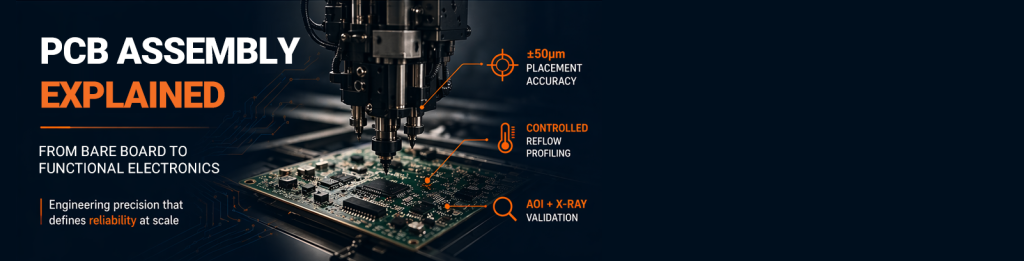
Behind every modern electronic product lies a critical manufacturing stage that often receives far less attention than it deserves: Printed Circuit Board Assembly (PCBA).
A printed circuit board, on its own, is merely a structural platform. It becomes a functional electronic system only once components are mounted, soldered, and validated through a tightly controlled assembly process. From medical equipment and industrial automation systems to aerospace electronics and IoT-enabled devices, PCB assembly represents the point where electronic design transitions into a working, scalable product.
Understanding how PCB assembly works—and where it can fail—offers a clearer view of how modern electronics are not only built but engineered for reliability.
PCB Assembly (PCBA) refers to the process of mounting electronic components onto a printed circuit board to create a functional electronic circuit.
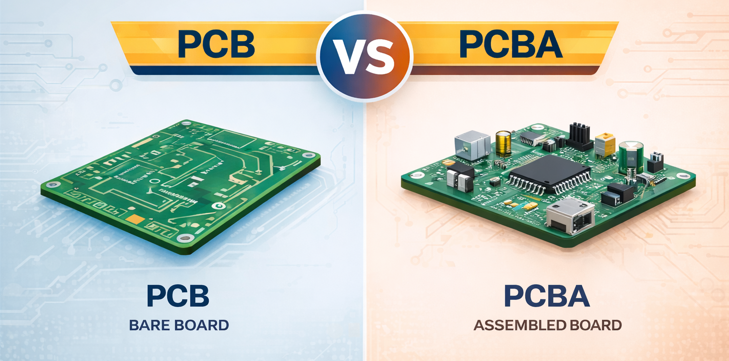
A PCB (Printed Circuit Board) is the bare board containing copper traces that define electrical pathways. A PCBA (Printed Circuit Board Assembly) is the completed board where components are mounted and soldered, enabling the circuit to perform its intended function.
During assembly, a range of electronic components are integrated, including:
Through a sequence of controlled and often automated processes, these components are electrically and mechanically connected to form a complete system.
In practice, PCBA determines not only whether a circuit works, but how consistently it performs under real-world electrical, thermal, and mechanical conditions.
While the exact workflow varies depending on product complexity, the PCB assembly manufacturing process typically follows a series of tightly controlled stages.
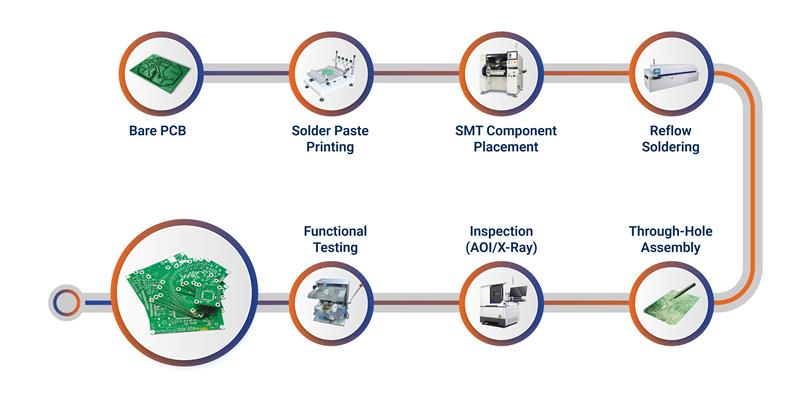
The process begins with the application of solder paste onto the PCB using a precision stencil.
The volume, alignment, and consistency of solder paste deposition are critical. Insufficient paste can lead to weak joints, while excess paste increases the risk of solder bridging and component tombstoning. Variations at this stage often propagate downstream, making early control essential for yield and reliability.
Automated pick-and-place machines position surface-mount components onto the board at high speed and precision.
Modern SMT systems operate with micron-level placement accuracy. However, as component density increases—especially in high-density interconnect (HDI) designs—placement tolerances become tighter. Even minor deviations can lead to misalignment, tombstoning, or poor solder joint formation.
Component packaging, board warpage, and stencil quality all influence SMT outcomes, making this stage highly sensitive to process control.
Once components are placed, the assembly passes through a reflow oven where solder paste is melted and solidified to form electrical connections.
The thermal profile during reflow is critical. Improper temperature ramp rates or peak temperatures can lead to:
Controlled cooling is equally important to prevent micro-cracks or long-term reliability issues caused by thermal fatigue.
Through-hole assembly is used for components requiring higher mechanical strength or current-carrying capacity, such as connectors, transformers, and power devices.
Component leads are inserted into drilled holes and soldered on the opposite side of the board. While less common in compact designs, THT remains essential in applications exposed to vibration, mechanical stress, or higher electrical loads.
Inspection is a critical checkpoint in PCB assembly, ensuring defects are identified before they propagate further.
Common inspection methods include:
Typical defects identified at this stage include:
Many of these defects may not cause immediate failure but can lead to intermittent faults or degradation under thermal cycling and operational stress.
After assembly, boards undergo functional validation to ensure they meet design specifications.
Testing methods may include:
This stage confirms that the board performs reliably under expected operating conditions and helps identify latent defects not visible through inspection alone.
In high-reliability applications, PCB assembly quality directly determines product performance and lifespan.
Even minor defects introduced during assembly can result in:
In high-volume production, these issues can scale rapidly, leading to increased field failures, warranty costs, and reputational risk.
For industries such as healthcare, aerospace, industrial automation, and connected systems, consistent assembly quality is not optional—it is fundamental to product reliability.
The importance of PCB assembly becomes most evident in environments where electronic systems must perform under demanding conditions.
Medical devices rely on highly controlled assembly processes to ensure continuous operation in applications such as patient monitoring and diagnostics. Failure in such systems can have serious consequences.
In agritech applications, electronics operate in environments characterized by temperature variation, humidity, dust, and mechanical exposure. This has increased demand for ruggedized PCBA capable of supporting sensors, irrigation controllers, and remote monitoring systems.
Similarly, industrial automation systems, aerospace electronics, and IoT devices operate under varying electrical loads and environmental stresses. In each case, long-term reliability depends directly on the precision and consistency of the PCB assembly process.
PCB assembly is not an isolated activity. It is part of a broader manufacturing ecosystem that includes process engineering, quality control, and design collaboration.
Experienced Electronics Manufacturing Services (EMS) providers support PCB assembly through:
This integration becomes especially important when transitioning from prototype to mass production, where small variations in process control can significantly impact product consistency and reliability.
Companies such as Aimtron Electronics focus on combining PCB assembly capabilities with engineering support, structured quality processes, and scalable manufacturing systems to help product teams move from validated designs to reliable production.
PCB assembly represents the critical transition from circuit design to functional hardware. A design that performs well in simulation or early prototyping must still prove its reliability under real manufacturing and operating conditions.
As electronic systems become more compact and complex, this transition demands not only precision manufacturing but also disciplined engineering processes and rigorous quality control.
In practice, the difference between a working prototype and a scalable product often lies in how effectively this transition is managed. PCB assembly is therefore not just a manufacturing step, but a controlled engineering process that determines whether a design can be reproduced consistently at scale.