
A hardware product rarely fails at the idea stage.
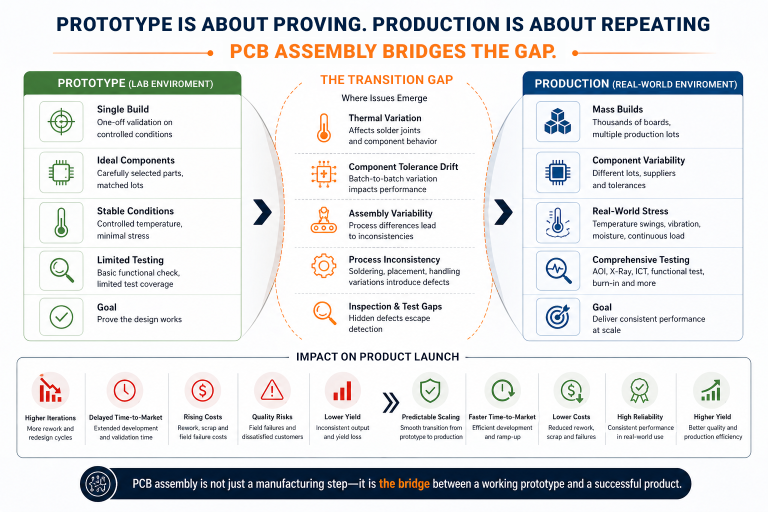
It fails later — often quietly — somewhere between a working prototype and a production-ready system.
On a lab bench, everything appears stable. The circuit performs as expected. Signals align, and the system responds correctly. From a design perspective, the product is considered “ready.”
Yet, as that same design moves toward production, outcomes begin to change.
Boards behave inconsistently. Components respond differently under thermal load. Assembly variations introduce defects that were never visible during prototyping. Iterations increase, timelines stretch, and costs begin to rise.
What worked once struggles to work repeatedly.
This is where many hardware products slow down — not because of poor design, but because of the complexity of translating that design into reliable, scalable hardware.
PCB Assembly (PCBA) is the process of mounting and soldering electronic components onto a printed circuit board, transforming it from a passive layout into a functional electronic system.
While the PCB provides the physical and electrical foundation, assembly determines how that system performs under real-world conditions.
This is where:
At the prototype stage, minor inconsistencies may go unnoticed. At production scale, the same inconsistencies result in yield loss, intermittent failures, or long-term reliability issues.
PCB assembly does not change the design — it determines whether the design can perform consistently.
Two products may share the same design, components, and intended functionality — yet their outcomes in production can be very different.
The difference often lies in how early manufacturing realities are integrated into the development process.
When factors such as design for manufacturability (DFM), component availability, and assembly constraints are considered early:
When these are ignored, issues compound as the product moves closer to scale.
In this sense, PCB assembly becomes less of a process step and more of a filter — determining whether a product is capable of scaling.
As electronic systems become more complex, the boundary between design and manufacturing continues to narrow.
PCB assembly is no longer a downstream activity — it is an integral part of product development.
In recent years, PCB assembly in India has evolved into a more capable and integrated ecosystem, supported by:
This evolution enables closer collaboration between design and manufacturing teams, resulting in:
Instead of fragmented workflows, product teams increasingly operate within integrated environments where design, assembly, and testing are aligned.
In many industries, the consequences of poor assembly are immediate and critical.
In these applications, PCB assembly is not just about building boards — it is about engineering reliability into every unit produced.
As systems become more complex, the margin for error reduces, and the importance of process control increases.
Speed in hardware is often misunderstood.
It is not defined by how quickly a prototype is built, but by how efficiently that prototype becomes a repeatable product.
The key factors that influence time-to-market include:
PCB assembly plays a central role in each of these factors.
For most hardware companies, the transition from prototype to production is not handled in isolation. It depends on the capabilities of the manufacturing partner.
An experienced EMS (Electronics Manufacturing Services) provider supports this transition by:
This alignment between engineering and manufacturing significantly reduces the risk between prototype validation and full-scale production.
At Aimtron, this approach is supported through integrated capabilities across design, PCB assembly, and box-build solutions — enabling product teams to move from concept to production with greater consistency and control.
In software, deployment can be immediate. In hardware, deployment is manufactured.
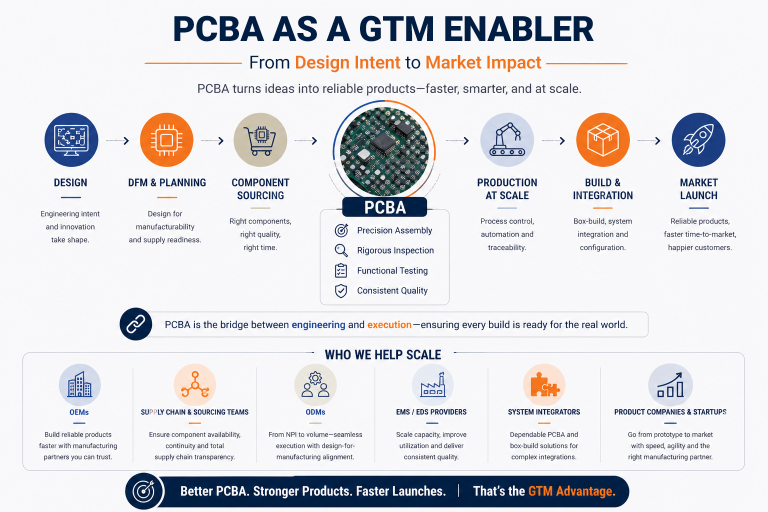
Between design and market lies a physical process that must be controlled, repeated, and validated at scale.
PCB assembly sits at the center of that process — not as a visible differentiator, but as a critical layer that determines whether a product can move from concept to consistent execution.
Because in hardware, success is not defined by a design that works once, but by a product that works reliably — every time it is built.